Improve your retentionGet more views
The Retention Lab is a place where YouTube creators grow their understanding of audience retention. Connect your channel(s) to explore your own retention charts, watch course material to learn more about what makes viewers watch longer, and share insights with a community of people who take retention as seriously as you do.
Create an account and you're straight in. Free to start, with Apprentice memberships open now and Scientist coming soon.
Built from retention work across 1B+ monthly views

Built by Mario Joos
Retention Director

CoursesRetention Course
 2m 6s
2m 6sLesson 1
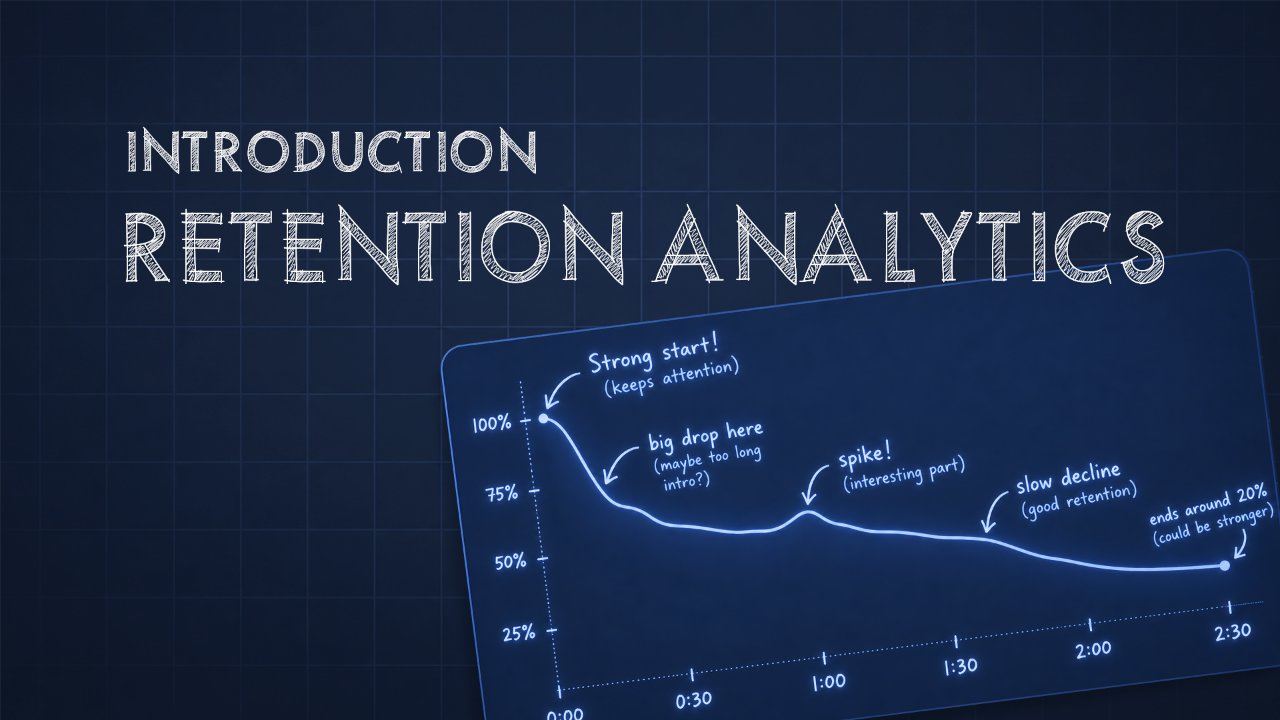
Introduction To Retention Analytics
Up next
1 / 18ReviewEscape 100 Cops, Win $500,000
Reviewed together
23 notes on this video
Notes
- 0:01Mario JoosThe high-intensity conflict situation is a great way to immediately increase arousal and activate noradrenaline, which makes the viewer more alert. Because there is obvious tension and uncertainty around what is going to happen next, the viewer has a stronger reason to keep processing the scene and wait to see what happens.
- 0:06Mario JoosThese initial seconds do a fantastic job of instantly establishing what the video is about, what the constraints for success are, and what the overall video goal is. At the same time, they establish the tone of the video, so the viewer very quickly understands what kind of experience they're about to have. A strong warm opening will often accomplish a few things at once: confirm the idea the viewer clicked for, provide the essential context they need to understand what is happening, establish a goal or direction for the video to progress toward, and communicate the tone of the experience. Together, these help remove uncertainty and allow the viewer to quickly decide, “Yes, this is the video I expected, and I want to keep watching."
- 0:09Mario JoosThe introduction of the timer is a good idea because it gives the experience a clear constraint and immediately creates some urgency. The problem is that starting the timer at 12 hours feels somewhat artificial because there isn’t a strong story reason for why 12 hours specifically determines whether the escape succeeds or fails. Right now, the primary obstacle is simply surviving until the timer reaches zero. That leaves a lot of possible ways to succeed without necessarily creating additional conflict. They could just hide for long enough. Because of that, the timer doesn’t inherently promise that the situation will become more difficult or interesting as the video progresses. A stronger structure would be to give them a specific destination or event that clearly represents success. For example, they could have to make it out of the country. Now the audience has a concrete finish line to track, and every police encounter directly threatens their ability to reach it. Instead of waiting for an arbitrary clock to expire, the characters are actively progressing toward something.
- 0:09Mario JoosThe third shot changes the angle from which we can see the police, but the actual visual information is still very similar to the previous shot. Because of that, the cut doesn’t introduce much new information or contrast, which can make the sequence feel visually repetitive. A stronger option would have been to return to the first shot and reconnect us with the creator. That would create more visual variation while also keeping the creator present as the main anchor of the scene. In that structure, the second shot works well as an establishing shot that briefly shows us the wider situation before we return to the person we are following.
- 0:16Mario JoosWhen the lead creator decides to temporarily escape the police by drifting the car, it turns him into an active protagonist. Instead of simply reacting to what is happening around him, he makes a decision that directly changes the situation. That agency is valuable because it gives the viewer someone whose choices they can follow. A more passive protagonist might simply wait for someone else to solve the problem or allow events to happen to them.
- 0:24Mario JoosWhile the explosion happening in the background may feel somewhat over the top, it serves an important function by making a promise about the type of experience the viewer can expect from the rest of the video. A moment like this immediately communicates spectacle. If the viewer finds that moment rewarding, it can create an expectation that similar moments may happen again later in the video. That anticipation of future rewarding moments can involve the brain’s dopamine system, which is strongly connected to motivation and reward-seeking behavior. In other words, the explosion is not only rewarding in the moment. It can also teach the viewer that this video may contain more moments like it.
- 0:32Mario JoosThe voiceover states that they just escaped from the real cops. However, this is something the viewer already just saw happen, so the voiceover isn’t really contributing any additional information. A better voiceover would have focused directly on what needs to happen next. Instead of repeating the action we just watched, it could use that moment to push the story forward and introduce the next problem. For example: “While this just bought us some time, we had to instantly come up with a plan and figure out how to keep this distance.” This way, the voiceover is actually adding something new. It takes the result of the previous moment and immediately turns it into the next question the viewer wants answered.
- 0:52Mario JoosWe’re now around the 50-second mark, which is where the actual story starts. This is actually a pretty good point for the story to have properly begun, because most viewers will want to feel like we’re moving forward by now. While 50 seconds is relatively long for an initial intro, our intro was a mix between a cold opening and a warm opening, which gives us a little more room to work with. We weren’t just explaining the premise, we were also already giving the viewer conflict, action, and a taste of what the video was going to feel like. The bigger question now becomes how quickly we introduce a new problem. At this point, the viewer understands the setup, understands the goal, and has seen the initial conflict. So if we stay in a relatively comfortable state for too long, this is where people may start tuning out. How quickly we create the next obstacle is going to be one of the biggest determining factors for whether the retention keeps up or not.
- 1:17Mario JoosThe problem we’re now starting to face is that we go from having an active protagonist, who escapes from the police in a very visual and conflict-heavy way, to suddenly having everyone become passive protagonists who are mostly just hiding. The problem with that is that the hiding itself doesn’t really promise a particularly exciting story. At the moment, the main promise is basically that the police are going to look in a lot of different places while we try not to get caught, and there isn’t much else actively developing beyond that. It would have been stronger if we had an actual plan for how to escape. For example, if the goal was to get out of the country, we could now start building a plan around which city to reach, which airport to get to, or even which plane to take. That would immediately create more active story threads and more opportunities for problems to happen along the way. Instead of the story becoming “let’s hide and hope they don’t find us,” it becomes “we have a plan, and now we need to see whether we can actually pull it off.”
- 1:18Mario JoosAnother problem we’re facing here is that the contrast between all of the participants isn’t clear enough. At the moment, everyone has basically been introduced as someone who is trying to hide, but we’re not really seeing enough personality differences through their behavior. Yes, the edit tried to make Allison’s introduction feel different with the little vine boom moment, but her actual behavior is still too similar to everyone else. What we really want is a bigger contrast in the way each person tries to overcome the same challenge. One person could decide to hide somewhere nobody would expect. Another could try to escape through an airport. Someone else could think about staying close to the police because they would never expect that, while the fourth person could start involving friends to help them. Now everyone is still trying to solve the exact same problem, but they’re doing it in completely different ways. That variety of strategies would naturally show more personality, create more different storylines to follow, and ultimately make the overall chase a lot more interesting.
- 1:19Mario JoosThe map graphic, especially when it’s executed in such a strong visual way, is a really effective way to transition between two scenes because it doesn’t just move us from one scene to another, it also gives the viewer spatial clarity. We refer to this graphic as a segmentation graphic. Instead of the transition feeling like we’ve simply cut to a new location, the map helps the viewer understand where people are and to whose perspective we’re going. That context matters because it reduces confusion.
- 1:38Mario JoosThis moment has a lot of tension, but it doesn’t feel very rewarding once the police actually find the person. The reason is that there wasn’t really any setup for why they would check it in the first place. The hay bales didn’t look suspicious, the police didn’t mention that something felt off, and there wasn’t any clue that naturally led them there. They simply arrive at the location and almost immediately check the exact place where someone is hiding. Because of that, the discovery feels more convenient than earned. That matters because once the viewer starts questioning whether a moment happened naturally, it can affect how they perceive the rest of the challenge. Instead of thinking, “How did the police figure that out?”, they may start thinking, “Did they already know where to look?” And once that doubt is introduced, future moments of tension can become less effective because the viewer may start questioning the validity of the challenge itself. An easy fix would’ve been to simply add more shots of them looking and introducing an extra voiceover line that raises suspicion.
- 1:56Mario JoosThe problem with showing someone getting caught this early is that the viewer now also learns what actually happens when a protagonist fails the challenge. And in this case, there doesn’t seem to be any meaningful negative consequence. That weakens the tension because the antagonist has a very clear motivation and a clear reason to succeed, while the protagonists are mostly just trying to escape. But escape toward what? Why does succeeding actually matter to them? And more importantly, what happens if they fail? If getting caught doesn’t really cost them anything, then every future chase becomes less threatening. The viewer may still enjoy the action itself, but the underlying stakes are much weaker because failure doesn’t seem to change anything. A stronger version would give the protagonists a clear consequence for getting caught, whether that’s losing money, losing access to something,, or creating another meaningful setback. That way, every time the police get close, the viewer immediately understands what is at risk.
- 2:09Mario JoosThis is the first moment since the beginning of the video where something genuinely interesting starts to happen again. We now have a plan being created, which is great because it immediately creates anticipation around whether that plan is actually going to work. What also helps is that the plan is being visualized, so the viewer can start imagining how it might play out before it even happens. At the same time, the strategy isn’t overly explained or completely thought through yet, which is actually a good thing because it leaves room for uncertainty. The viewer can already start thinking about all of the things that could possibly go wrong. Being vocal about strategy can be really good for retention because it gives the viewer something specific to track. They’re no longer just watching events happen, they understand the intention behind the next move.
- 2:26Mario JoosWhile everything that’s happening is serving the actual story, the problem we’re facing is that we haven’t really developed much character care yet. Character care is often built through smaller moments that make us like or understand the people we’re watching. That could be seeing them in a nicer situation, seeing them do something good for each other, or even just having a joke or interaction that makes them feel more human. Right now, the characters are mostly serving as vehicles to move the story forward, but we don’t really know much about their personalities or motivations beyond escaping the police. Because of that, it becomes much harder for the viewer to actually care whether they succeed or fail. The more we understand who these people are and start liking them as individuals, the more emotionally invested we can become in what happens to them.
- 2:37Mario JoosA whole lot of time has passed, but the problem here is that the police still haven’t really taken action to continue the chase. We have a time constraint, yet the police don’t seem to be acting with any urgency around that constraint, and we’re also not given a reason for why they’re slowing down. Instead, they seem to be celebrating their early success. The problem with that is that it starts highlighting flaws in the antagonists very early in the video. Ideally, we want the antagonist to continue feeling powerful, capable, and dangerous, because that makes every future encounter with them feel more threatening. We’re also missing a reminder of the time constraint here. We’ve just gone through a big moment followed by an explanation, so there’s a risk that the viewer has lost track of how much time has passed and how much time is still left. A quick timer reminder here would help re-establish the urgency and remind the viewer that the challenge is still progressing.
- 2:55Mario JoosThere we go. Here’s the negative consequence. This is a really good thing because now we finally understand why the participants are motivated to avoid getting caught. However, there is still one problem: what is in it for Jimmy himself? Jimmy is already known for having a lot of money, so the same financial motivation may not feel as meaningful for him. That means the viewer still needs to understand what he personally stands to gain or lose. It’s important that we understand the motivation of all the main characters, not just some of them. And the existing perception of someone like Jimmy matters here as well. If the audience already sees money as something that isn’t particularly valuable to him, then we need another reason for why succeeding in this challenge actually matters to him.
- 3:21Mario JoosWe have a problem with the music here. The music itself is high in arousal, which is great when we want to create emotions like fear, urgency, or anxiety. The problem is that this scene doesn’t really have the necessary story conditions for that level of intensity yet. The police aren’t close to us, there isn’t an immediate threat, and we’re not currently in a moment where something urgent needs to happen. What we actually need here is tension. We’re preparing ourselves for a plan, we don’t know exactly how it’s going to go, and there’s uncertainty around what could happen next. So a better option would be low arousal music with low valence. That would allow the viewer to sit more in the uncertainty of the moment rather than feeling like the scene is already pushing toward fear or urgency. The cinematic feeling itself isn’t the problem. It’s just that the emotional intensity of the music is ahead of what the story is currently giving us.
- 3:34Mario JoosThe entire way this scene is filmed feels very weird. We have these speed ramps, the camera mostly stays on the people, and there’s almost no spatial clarity around where the police actually are. We don’t really get an establishing shot that helps us understand the environment, the distance between everyone, or how close the threat actually is. The speeding up also doesn’t really work for the type of tension we’re trying to create here. What we need is much more of a second-to-second progression where the viewer feels like they’re watching the plan unfold in real time. We should see the characters make a move, understand where the police are, see how the police respond, and slowly feel that distance between them change. Instead, it currently feels more like a montage of small moments and voice lines. That removes a lot of the uncertainty because we’re not really experiencing the plan alongside the characters. We’re mostly being shown a summarized version of what happened. I don’t really understand what the scene is trying to achieve with this approach. It almost feels like the viewer is being asked to wait until the normal storytelling starts again. And it also hurts immersion, because immersion often comes from experiencing those moment-to-moment interactions and feeling like events are happening in front of you rather than being summarized after the fact.
- 3:43Mario JoosWhile there is now a difference in the strategies being presented, the problem is that those strategies still don’t really tell us much about the people themselves. Why does one person decide to take the subway? Is that part of a specific hiding strategy? Why does another person choose to confront the situation differently? We need to understand the reasoning behind some of these decisions, because that reasoning is where we actually start learning something about the characters. If someone takes the subway because they think the obvious escape is the safest option, that tells us something about how they think. If someone else chooses a much riskier strategy because they’re more confident, that immediately gives us a different impression of them. And that matters because we don’t just want different strategies for the sake of variety. We want those strategies to reveal personality. The more we understand how each person thinks and why they make certain decisions, the easier it becomes for the viewer to figure out who they connect with and who they want to invest their attention in.
- 4:17Mario JoosWe have a pretty massive continuity problem here, and that also makes the entire scene come across as less believable. The reason is really the combination of those two things. While Tareq and Allison are trying to escape from the cops, we present the situation as if everything is happening in real time. But we never actually get an establishing shot where we see both the police and the escapees in the same space. Then, when we finally cut to the police, they’re suddenly in jail at what appears to be a completely different location. That creates a problem because the viewer can start connecting those two dots. They may think, “I never actually saw the police near them, and now the first time I see the police again, they’re somewhere completely different. So was that previous chase even real?” And whether the scene was actually fake or not almost doesn’t matter at that point. What matters is the viewer’s perception of it. If the edit creates enough inconsistencies that the viewer starts questioning the validity of what they’re seeing, then the authenticity of the entire challenge starts taking a hit. This is authenticity 101. Believability comes from giving the viewer enough visual evidence to trust that the events they’re watching are actually connected.
- 4:22Mario JoosNow we keep going back to Darius in his jail cell, but there isn’t really a clear reason for us to return to him. He’s already eliminated, so from the viewer’s perspective, his role in the main story is basically finished. If we do want to keep cutting back to him, there needs to be a clear motivation for why. Maybe he has information that affects the others, maybe something is developing around him, or maybe his reactions are somehow contributing to the story. But right now, it mostly feels like we’re trying to keep him alive in the video even though his storyline has already ended. That can create confusion around where the viewer is supposed to focus. Are we still supposed to care about Darius? Is something going to happen with him? Or should our attention be on the people who are still actively trying to escape? That clarity around focus is really important because the viewer relies on the edit to tell them what matters. If we keep bringing attention back to a character whose story is already resolved, we risk weakening the focus of the main story and making the overall experience feel less clear and engaging.
- 5:15Mario JoosThe entire scene feels a little off. First of all, we already established that the police had been here and searched the place. So the question becomes: why are we now destroying everything in a location the police have already checked? The police also weren’t aware that the television was being used as a surveillance tool, so Jimmy’s motivation for suddenly destroying things isn’t really clear. We don’t understand what information caused him to take this action or why he believes it will help him. That lack of character motivation creates confusion, and again, it starts feeding into the bigger authenticity problem. The viewer may begin questioning whether these decisions are actually happening naturally within the challenge, or whether they’re being done because the video needs something to happen.
Terminology
Defined once, linked to the lessons that teach them.
- Absolute Retention LossAbsolute retention loss is the total drop in audience retention between two points in a video.
- Active EngagementActive engagement is when a viewer takes a clear action that shows interest in the video, such as liking, commenting, sharing, rewinding, or clicking something to learn more.
- Active ProtagonistActive protagonist is a main character who makes choices, takes action, and drives the story forward.
- Affective EmpathyAffective empathy, also known as emotional empathy, is when you emotionally feel what another person is feeling.
- Auditory ClarityAuditory clarity is how clearly the viewer can understand the important sounds in a video and what those sounds are meant to communicate. These sounds can include spoken words, music, sound effects, silence, reactions, and background noise.
- Auditory RepetitionAuditory repetition is when the viewer repeatedly hears the same music, sounds, vocal patterns, rhythm, or audio style, which can make the video feel as though it is not progressing.
- Authority BiasAuthority bias is the tendency to trust or believe information more because it comes from someone perceived as an expert or authority.
- Bayesian ThinkingBayesian thinking is a way of forming judgments by combining what you already know with new evidence and updating your beliefs as more information becomes available.
- Chekhov's GunChekhov’s gun is a storytelling principle where an important element introduced earlier should serve a purpose or become relevant later.
- Cognitive easeCognitive ease is the psychological state where the brain feels comfortable because something is simple to process.
- Cognitive EmpathyCognitive empathy is when you understand another person’s feelings, thoughts, or perspective without necessarily feeling the same emotion yourself.
- Cognitive loadCognitive load is the amount of mental effort the viewer has to use.
- Continuity ErrorContinuity error is a mistake where something changes between shots in a way that does not make sense within the video, such as an object moving, clothing changing, or an action not matching.
- Cross-cuttingCross-cutting is an editing technique that cuts back and forth between two or more scenes, usually to show actions happening in different places and build a connection between them.
- Diegetic SoundDiegetic sound is sound that exists within the world of the video and could be heard by the people in the scene, such as dialogue, footsteps, or a car engine.
- DopamineDopamine is a brain chemical involved in motivation, learning, and the expectation of rewards. It can increase when something feels promising or when the outcome is uncertain, encouraging us to keep going.
- Dwell TimeDwell time is the amount of time a visual or piece of text remains understandable after the viewer first processes it, allowing them to explore or absorb the rest of the scene.
- EndorphinEndorphins are brain chemicals that help reduce pain and can create feelings of pleasure, relief, or satisfaction, especially during or after high effort.
- Establishing ShotEstablishing shot is a shot that shows where a scene is happening and gives the viewer the context needed to understand the location and situation.
- Focal PointFocal point is the part of an image that is intended to attract the viewer’s attention most strongly.
- Implied RepetitionImplied repetition is when two moments appear different on the surface but communicate the same underlying meaning, idea, or information.
- Inciting IncidentInciting incident is the event that begins the main story, conflict, or challenge and gives the protagonist a reason, or forces them, to take action.
- Internal GoalInternal goal is an emotional or personal outcome a person wants to experience, such as feeling accepted, respected, safe, confident, or understood.
- J-CutJ-cut is a transition where the audio from the next shot begins before the visual changes to that shot.
- L-CutL-cut is a transition where the audio from the previous shot continues after the visual has already changed to the next shot.
- NoradrenalineNoradrenaline is a brain chemical that increases alertness, attention, and readiness to act, especially when something feels urgent, important, risky, or unexpected.
- Parallel EditingParallel editing is when two or more scenes or storylines are shown alongside each other to suggest that they are connected, similar, or happening at the same time.
- Peak-end RulePeak-end rule is the tendency to judge an experience mainly by its most intense moment and how it ended, rather than by every moment equally.
- Practical RelevancePractical relevance is how useful or applicable information feels to the viewer. It creates interest because the viewer believes they can learn something, solve a problem, make a better decision, or use the information in their own life.
- Retention BucketRetention bucket is a specific time portion of a video that retention is measured against.
- Short-term MemoryShort-term memory is the brain’s temporary storage for a small amount of information that is needed for a short period of time.
- Spatial ClaritySpatial clarity is how easily the viewer can understand where people, objects, and events are located in relation to one another. It helps the viewer understand things such as where the action is happening, which direction someone is moving, and how far a person is from a destination, obstacle, or threat.
- Structural ClarityStructural clarity is how easily the viewer can understand how a video is organized, how each part connects to the next, and where they are within the overall progression of the video.
- Success MetricSuccess metric is the main number used to judge whether a specific goal has been achieved.
- Underdog EffectUnderdog effect is the tendency to support or root for someone who is less likely to win or who faces a clear disadvantage.
- Vigilant AttentionVigilant attention is the ability to stay focused and ready to notice important information during a simple, repetitive, or unstimulating task.
- Visual RepetitionVisual repetition is when the viewer repeatedly sees the same type of shot, framing, image, movement, setting, or visual idea.
- Visual VarietyVisual variety is the use of meaningful changes in what the viewer sees so that the video does not become visually repetitive.
- Warm OpeningWarm opening is when a video begins by giving the viewer context, explanation, or setup before moving into the main action or content.
- Weasel WordWeasel words are vague or qualifying words that make a statement less clear, direct, or meaningful, such as “maybe,” “somewhat,” “possibly,” “kind of,” or “it seems.”
Start here
- get-started
- announcements
Talk
- general-chat
- ask-mario
- share-your-work
- J
Jamie2:14 PM
My intro loses a third of viewers in the first ten seconds. Where do I start?
- A
Alex2:16 PM
Check how long the setup runs before the first payoff. That drop is usually cognitive load.
- M
MarioFounder2:21 PM
Post it in #share-your-workand we'll go through it together.
Courses · Short lessons on what the retention chart is really measuring.
Questions, answered
What is The Retention Lab?
The Retention Lab is a place for YouTube creators to deeply understand audience retention. It combines learning, your own channel data, practical tools, live sessions, and a community of people who take retention seriously.
Is The Retention Lab just a course?
No. The course is only one part of it. The Retention Lab is something you can keep coming back to as you create, analyze videos, learn new concepts, review your retention, and improve over time.
Can I connect my own YouTube channel?
Yes. You can connect your channel and explore the retention of your own videos, making it easier to apply what you learn directly to the content you’re creating. We request read-only access, never modify your channel, and never sell your data. Your analysis is private to you. The full detail is in our Privacy Policy at /privacy.
When can I get in?
Now. The lab is in beta: create an account and you're straight in. It's free to start, Apprentice memberships are open, and Scientist is coming soon.
Is this only for large creators?
No. The Retention Lab is built around understanding viewers, not channel size. Whether you’re still growing or already getting millions of views, the same underlying principles of retention still count.
Why do you ask to connect my YouTube account?
Connecting is optional, and the lab only works with data you already own: your own YouTube analytics.
- Read-only access: the youtube.readonly and yt-analytics.readonly permissions, so we can read your channel, your videos, and their retention and watch-time statistics.
- It's used for one thing: showing you the analysis of your own channel inside the lab.
- We never change your channel, post or act as you, sell your data, or use it for advertising.
- It stays private to you, unless you deliberately submit one of your videos for community feedback.
- You can disconnect at any time, from the lab or from your Google account, and the channel data we hold is deleted.
Every field we store and how long we keep it is in our Privacy Policy. Connected YouTube data is also subject to the YouTube Terms of Service and the Google Privacy Policy.